
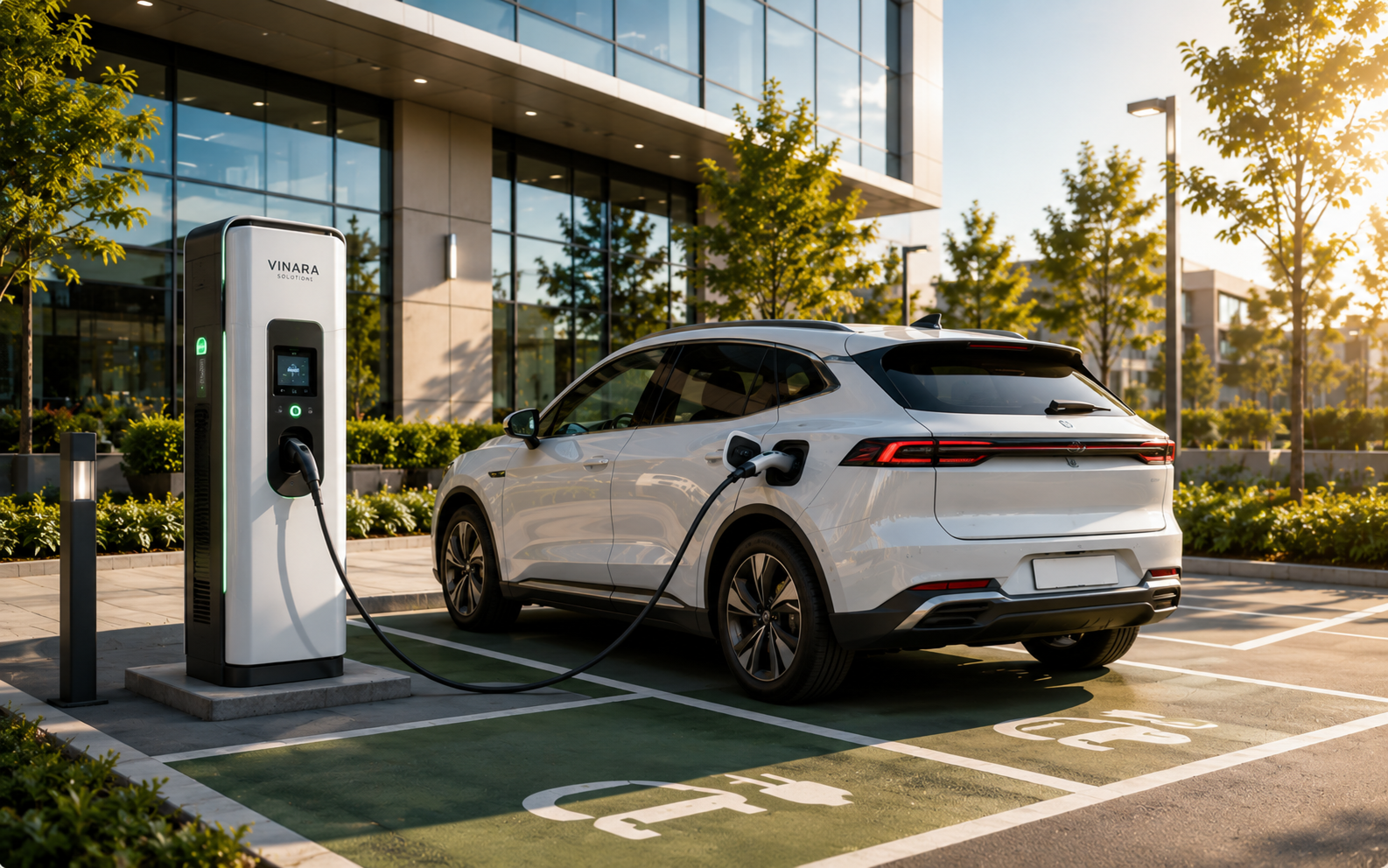
India crossed 2 million cumulative EV sales in 2025, and the growth curve is steepening. Businesses — from IT parks and hotels to hospitals and retail malls — are discovering that EV charging infrastructure is no longer a nice-to-have. It is increasingly a requirement for attracting employees, customers, and tenants who drive electric vehicles.
Understanding EV Charger Types
Not all EV chargers are alike. The right choice depends on your use case, the types of vehicles visiting your site, and how long those vehicles typically dwell.
AC Level 2 Chargers (3.3 kW – 22 kW)
These are the most common choice for workplaces, apartments, and commercial premises. A 7.4 kW charger adds roughly 40–50 km of range per hour of charging — enough to fully charge most electric cars in four to eight hours, making them ideal for vehicles parked during a workday or overnight. Installation typically requires a single-phase (for up to 7.4 kW) or three-phase (for 11–22 kW) power supply and a dedicated circuit breaker. Cost per point ranges from ₹30,000 to ₹80,000 depending on charging speed, smart connectivity, and mounting type.
DC Fast Chargers (30 kW – 150 kW+)
DC fast chargers bypass the vehicle's onboard charger and deliver power directly to the battery, cutting charge times dramatically. A 60 kW DC fast charger can add 200–300 km of range in under 30 minutes. These are suited for fuel-station-style locations, highway stops, and fleet depots. They require a three-phase connection and typically a transformer upgrade, making installation costs higher — typically ₹3 lakh to ₹12 lakh per unit — but the revenue potential from pay-per-use charging is correspondingly greater.
Key Considerations for Business Installations
Power Availability and Load Management
Before installing chargers, an electrical audit is essential. Multiple simultaneous EV charges draw significant power, and most commercial premises have a sanctioned load that may need to be upgraded. Smart load-management systems (sometimes called energy management systems or EMS) can dynamically distribute available power across multiple chargers, preventing demand peaks and avoiding excess tariff charges from the DISCOM.
Smart Connectivity and Billing
Modern EV chargers connect to a cloud platform via Wi-Fi or SIM, enabling features like remote monitoring, access control via RFID cards or app, per-user billing, and usage analytics. For businesses offering EV charging as a paid service, OCPP-compliant chargers integrated with a charging management system (CMS) make billing, maintenance scheduling, and fleet reporting straightforward.
FAME III and State Incentives
India's FAME III policy framework (successor to FAME II, operationalised in 2025–26) continues to provide capital subsidies for EV charging infrastructure in commercial and public spaces. Gujarat additionally offers power tariff concessions for EV charging stations registered under the state EV policy. Businesses can significantly reduce their capital expenditure by applying for these incentives before installation — your installer should be familiar with the process.
ROI for Commercial EV Charging
For a workplace offering free charging as an employee benefit, the ROI comes indirectly — through talent attraction, employee satisfaction, and CSR / ESG reporting. For a business running pay-per-use charging, revenues of ₹15–20 per unit (kWh) at typical utilisation rates (30–40% of charger capacity) can recover a 7.4 kW AC charger investment in under two years, with higher-traffic DC fast chargers recovering costs even faster.
Planning Your Installation
- Start with a site assessment: Understand your current electrical capacity, parking layout, and anticipated demand (how many EVs are likely to need charging simultaneously?).
- Choose the right charging speed: Match charger output to dwell time — AC for workplaces and apartments, DC for transit-oriented or high-turnover locations.
- Future-proof your infrastructure: Install conduit and cabling capacity for double the chargers you plan to install initially. Trenching and civil work is the expensive part — adding more charger units later is straightforward if the infrastructure is ready.
- Get a certified installer: EV charger installations must comply with CEI (Central Electricity Inspectorate) requirements. Always use a licensed electrical contractor familiar with EV charging systems.
Vinara Solutions has installed over 350 EV charging points across residential societies, commercial complexes, and industrial sites in Gujarat and Maharashtra. Contact us for a no-obligation site assessment and proposal.