
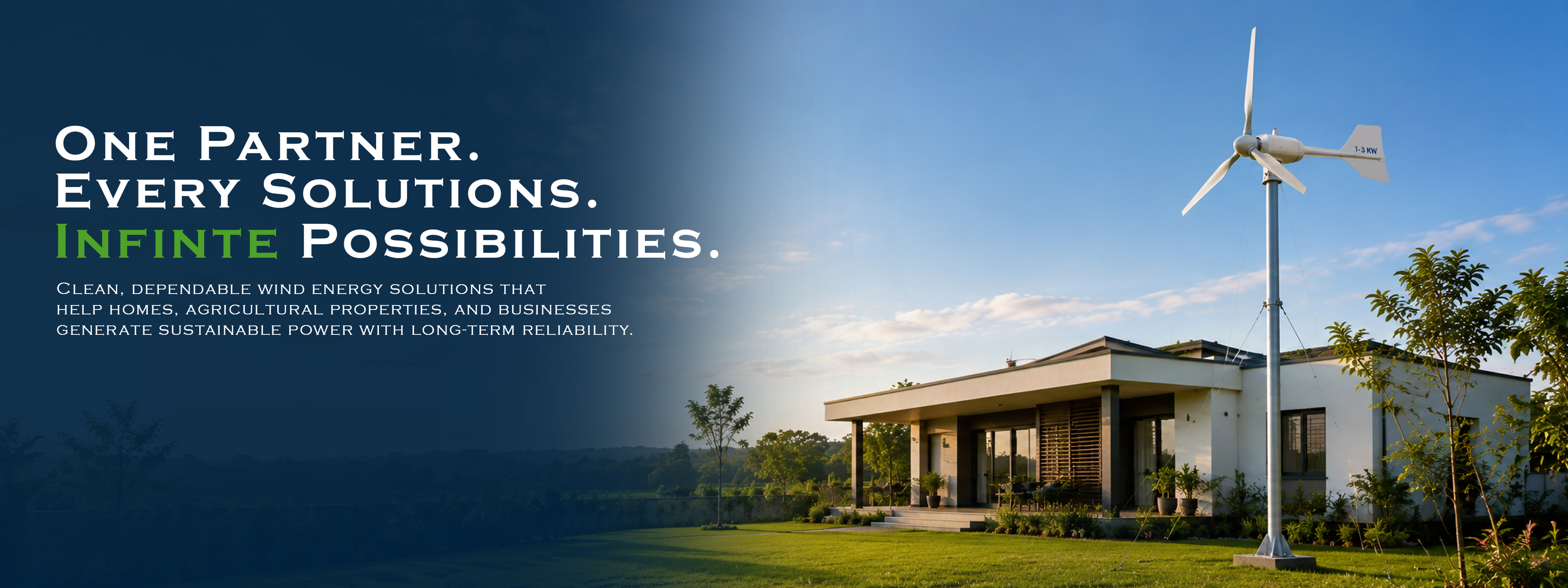
When most people think of renewable energy for their home, solar panels come to mind first. But for properties with good wind resources — particularly agricultural land, rural homes, and coastal or elevated sites — small wind turbines can be a compelling option, either standalone or as part of a hybrid solar-wind system.
How Small Wind Turbines Work
A small wind turbine (typically 1–10 kW for residential or small commercial use) captures kinetic energy from the wind using rotating blades and converts it to electricity via a generator. Unlike solar panels, which produce power only during daylight, wind turbines can generate at any hour — including overnight and during cloudy weather. This complementary generation profile makes wind particularly attractive as a pairing with solar.
What Wind Speed Do You Need?
The power output of a wind turbine scales with the cube of wind speed — meaning a small increase in average wind speed makes a large difference in annual generation. Most small turbines reach their rated output at wind speeds of 11–13 m/s, but they begin generating usefully from around 3–4 m/s. An average annual wind speed of at least 5 m/s is generally considered the minimum for a home wind turbine to make economic sense.
In India, the best wind resources for small turbines are found in:
- Coastal and near-coastal areas of Gujarat (Kutch, Saurashtra coast)
- The Western Ghats foothills and elevated plateau areas in Maharashtra, Karnataka, and Tamil Nadu
- Rajasthan's semi-arid regions
- Parts of Andhra Pradesh, Telangana, and Odisha
Before investing, it is worth having a wind resource assessment done at your specific site — local topography, obstacles, and seasonal variation all affect real-world output significantly.
Costs and Realistic Output
A 1–2 kW small wind turbine in India (including tower, inverter, and installation) typically costs between ₹2.5 lakh and ₹5 lakh. A 5 kW system ranges from ₹8 lakh to ₹14 lakh. At an average wind speed of 6 m/s, a 1 kW turbine generates roughly 1,500–2,000 kWh per year — enough to cover about 30–40% of an average home's electricity consumption.
Payback periods for standalone small wind systems in India range from 8 to 14 years at typical residential electricity tariffs — longer than rooftop solar. However, in locations with genuinely strong wind resources (average speed above 6.5 m/s), payback can be as short as 5–7 years, and the turbine's 20+ year design life means it will provide substantial free energy long after recovery.
The Hybrid Advantage: Solar + Wind
Combining solar and wind on the same site (with a shared battery bank or grid-tied inverter system) offers several advantages:
- Complementary generation profiles: Wind often peaks in early morning, evening, and during monsoon months — exactly when solar production dips. A hybrid system provides more consistent year-round generation.
- Better battery utilisation: Batteries in a hybrid system are cycled more evenly, extending their life.
- Grid independence: For farms and remote properties, a solar-wind-battery combination can achieve a very high degree of energy self-sufficiency.
Installation and Grid Connection
Small wind turbines require a tower — typically 15–30 metres tall to clear turbulence from buildings and trees. Guy-wire towers are common for small systems and are more economical than freestanding lattice towers. Local authority permissions and aviation authority (DGCA) clearance may be required for taller towers.
For grid-tied systems, the same net metering provisions that apply to solar in Gujarat and most Indian states also cover small wind turbines — meaning surplus generation earns credits on your electricity bill.
Is It Right for You?
A home wind turbine makes the most sense if: (1) your property has consistently good wind (ideally confirmed by a short-term wind measurement), (2) you have sufficient open land for a tower with proper setbacks from buildings and property boundaries, and (3) you are interested in a hybrid approach to maximise year-round renewable generation. For urban rooftops or sites with variable or low average wind speeds, solar remains the better primary investment.
Vinara Solutions can assess your site's wind potential and design a system — standalone or hybrid — that makes the most of your specific location and energy needs.